


Introduction
Last week, I was invited to a retail conference hosted by Barclays, as part of my summer internship at Retail Economics. During the event, a single comment caught my attention, which in turn gave rise to the entirety of this article.
A speaker at the conference emphasised that in the near future, retailers will need to adapt their marketing strategies to capture the attention of AI and bots that will soon be shopping on consumers’ behalf.
It sounded abstract at first, yet the more I thought about it, the clearer it became that this idea relates to how technology is quietly reshaping the very foundations of consumer behaviour and market competition that we come across in A-level Economics.
Foundations
At its heart, marketing is an economic mechanism for influencing demand. We learn early on that the quantity demanded of a good doesn’t depend solely on price. Instead, it’s shaped by several non-price factors, often summarised by the acronym ‘PACIFISES’ (Population, Advertising, Complements, Income, Fashion, Interest rates, Substitutes, External shock, and Season) (Theme 1.2.2).
Of these factors, it is advertising that captures the essence of marketing. Through clever branding, emotional storytelling, and targeted promotions, it’s how firms influence consumer preferences, encouraging consumers to shift their demand curve outwards.
In short, marketing serves two major economic functions: it communicates information and influences demand. Yet both rely on one simple assumption – that the consumer is human. Driven by emotion, habit, and imperfect information.
But what happens when that assumption no longer holds – or in other words – when the buyer isn’t human at all?
Analysis
Enter the AI Shopper
Imagine telling your phone:
“Order my usual groceries this week, but pick cheaper alternatives for anything that’s gone up more than 10%.”
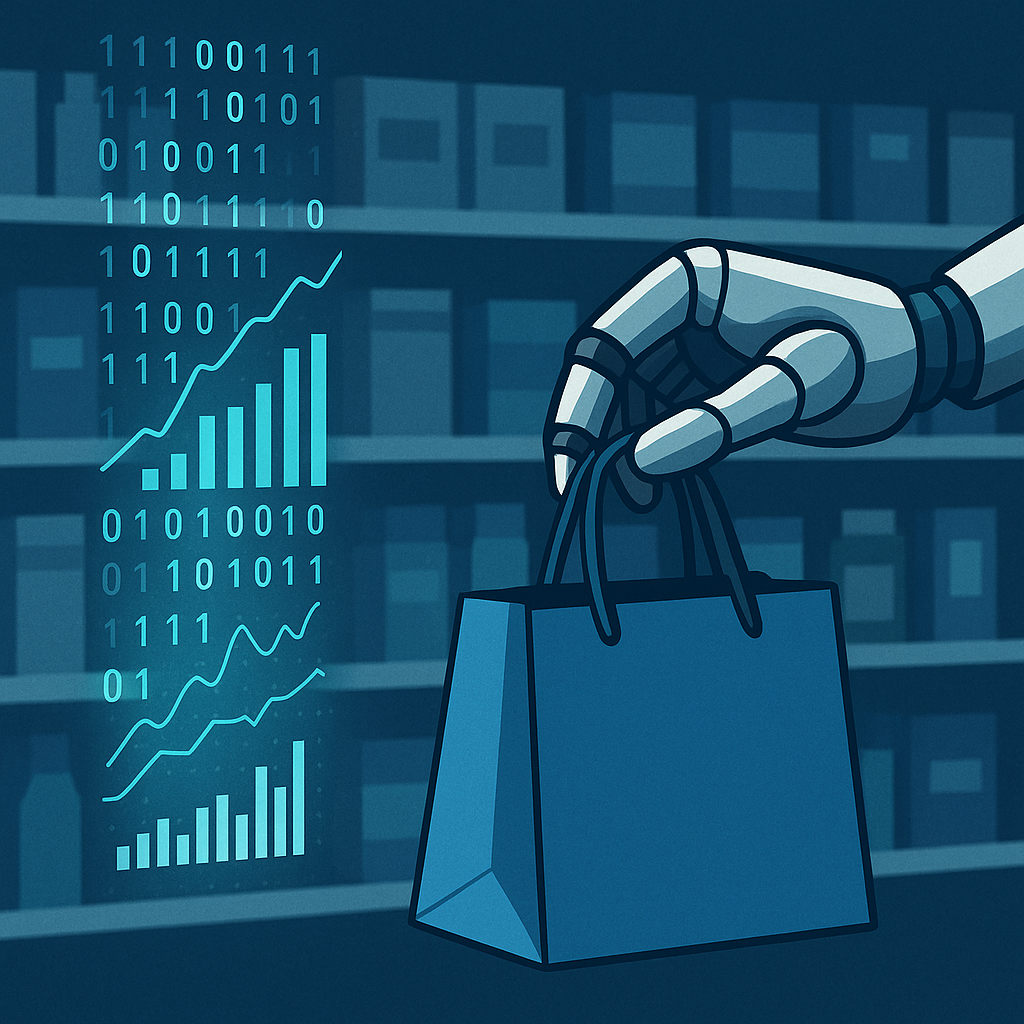
That kind of instruction isn’t far off. Tech companies are already developing AI shopping agents – digital assistants capable of understanding your preferences, scanning product data across thousands of sites, and then making purchases on your behalf. While still in their early stages, these systems are being rolled out gradually, and are expected to become a familiar part of everyday consumption within the next few years.
Unlike current AI assistants, which simply follow direct commands and respond to prompts, these new AI agents can make independent decisions. That means, within seconds, it could scan thousands of products, compare prices, check nutritional data, read verified reviews, before placing an order autonomously. No browsing, no brand loyalty, no impulse purchases.
From an economic standpoint, this changes everything we assume about consumer behaviour. Traditional models treat the consumer as human – emotional, imperfect, and influenced by perception as much as by price. But an AI consumer, in theory, is perfectly rational. It doesn’t respond to a celebrity endorsement or a limited-edition label. It responds to data.
For marketers, this changes the rules of the game. The tools that once drove demand, be it packaging, slogans, or emotional storytelling, begin to lose power. A human shopper might pay extra for a familiar cereal brand because of nostalgia or perceived quality. An AI shopper, by contrast, will evaluate objective variables such as price per gram, nutritional value, or average delivery time. It will purchase whichever option best meets its programmed criteria.
Competing for Algorithmic Attention
If you’re a retailer today, your first goal is to grab human attention. If you’re a retailer tomorrow, your first goal will be to grab algorithmic attention.
For businesses, this shift will present a profound challenge in how competitive marketing works. At present, marketing is about visibility, capturing attention through adverts, packaging, and storytelling. In the near future, it will be about technical legibility, ensuring that algorithms can read, understand, and trust your product data.
Brands that once relied on persuasion will now rely on proof: verified information, transparency, and measurable value. A product description written to persuade a person will increasingly need to inform an algorithm, ensuring that it meets the consumer’s criteria when their AI agent compares alternatives. For this same reason, a firm’s marketing team may soon include not only copywriters and designers, but data engineers and API specialists, who’s goal is to make their brand discoverable and trustworthy to both humans and machines alike.
Bridging the Gap
At first glance, all this talk about “marketing to machines” might seem distant from your A-level syllabus. But beneath the surface, it connects directly to several specification topics:
Demand and Advertising (Theme 1.2.2)
As we briefly explored in the foundations section, advertising is a non-price factor shifting the demand curve. Here, the mechanism is beginning to evolve: AI agents can now filter or even reinterpret advertising information, meaning the traditional demand-shifting power of marketing might weaken.
This could make demand more price-elastic, as emotional loyalty gives way to rational, data-driven choices. When demand becomes more elastic, firms lose some of their pricing power – a small rise in price now leads to a proportionally larger fall in quantity demanded. This forces firms to compete more strongly on objective measures of quality and value rather than image or branding, since these are the features algorithms will prioritise when deciding what to purchase.
Information and Market Failure (Theme 1.3.4)
A-level Economics underpins that asymmetric information can cause market failure when buyers and sellers have unequal knowledge, for example from misleading adverts. AI agents could drastically reduce any existing information gaps, comparing thousands of products instantly and identifying false or exaggerated claims within marketing campaigns.
This reduces search costs for consumers, helping them identify the best-value products more easily. As a result, fewer resources are wasted on poor-quality or misrepresented goods, leading to greater allocative efficiency, where resources flow towards firms producing goods that genuinely meet consumer needs.
Dynamic Efficiency and R&D (Theme 3.4.1)
As firms face more rational and informed consumers, they might respond to this shift by heavily investing in R&D and data innovation. These are forms of dynamic efficiency, where innovation improves long-run competitiveness through reduced costs and/or improved product quality. At a macro level, this can even stimulate long-run economic growth. More investment in technology and product development raises productivity, shifting the long-run aggregate supply (LRAS) curve to the right, in turn allowing for non-inflationary growth – a key supply-side benefit that links technological change directly to macroeconomic performance.
Evaluation: Cost pressures and Monopoly Power
While AI systems may enhance efficiency in theory, the implementation process could create new barriers to entry. If smaller firms lack the resources to produce structured, machine-readable data, they risk losing visibility within algorithmic markets. This reduces contestability and allows dominant platforms to act as digital gatekeepers, setting the rules, charging higher fees, or prioritising their own products which strengthens the position of large firms like Amazon that already command online platforms. As a result, this leads to a weakening of the competitive benefits that AI was supposed to deliver.
Evaluation 2: Data Bias and Uneven Access
Efficiency gains also rely on the assumption that AI agents operate with accurate and accessible information. If algorithms are trained on biased or incomplete data, they may mis-rank products or favour certain firms, reintroducing the same information failure that we were trying to correct. Larger companies in the industry may even be able to impose significant influence in the manner in which these agents are trained. This can misallocate resources and undermine consumer trust.
Key Takeaways & Conclusion
The rise of AI shoppers will mark one of the most significant turning points in how markets function. For decades, marketing has been about shaping perception, building loyalty, and shifting demand through emotional connection. But as decision-making moves from humans to algorithms, persuasion gives way to proof. The most successful firms of the future will be those that can communicate product-merit and value in a language machines understand: clear data, verified quality, and transparent pricing.
From an economic perspective, this shift touches on many of the key ideas A-level students already study: demand, information failure, efficiency, and market structures. AI agents may bring markets closer to the model of perfect competition by improving information and reducing irrational behaviour, yet they also risk concentrating power among a few digital giants. The outcome will depend on how effectively firms and regulators balance innovation with accessibility and fairness.
In essence, the invisible hand of the market may soon belong to an algorithm, allocating resources not through persuasion or instinct, but through data and trust.
